Garage Door Reverses or Won't Close? Check Your Safety Sensors
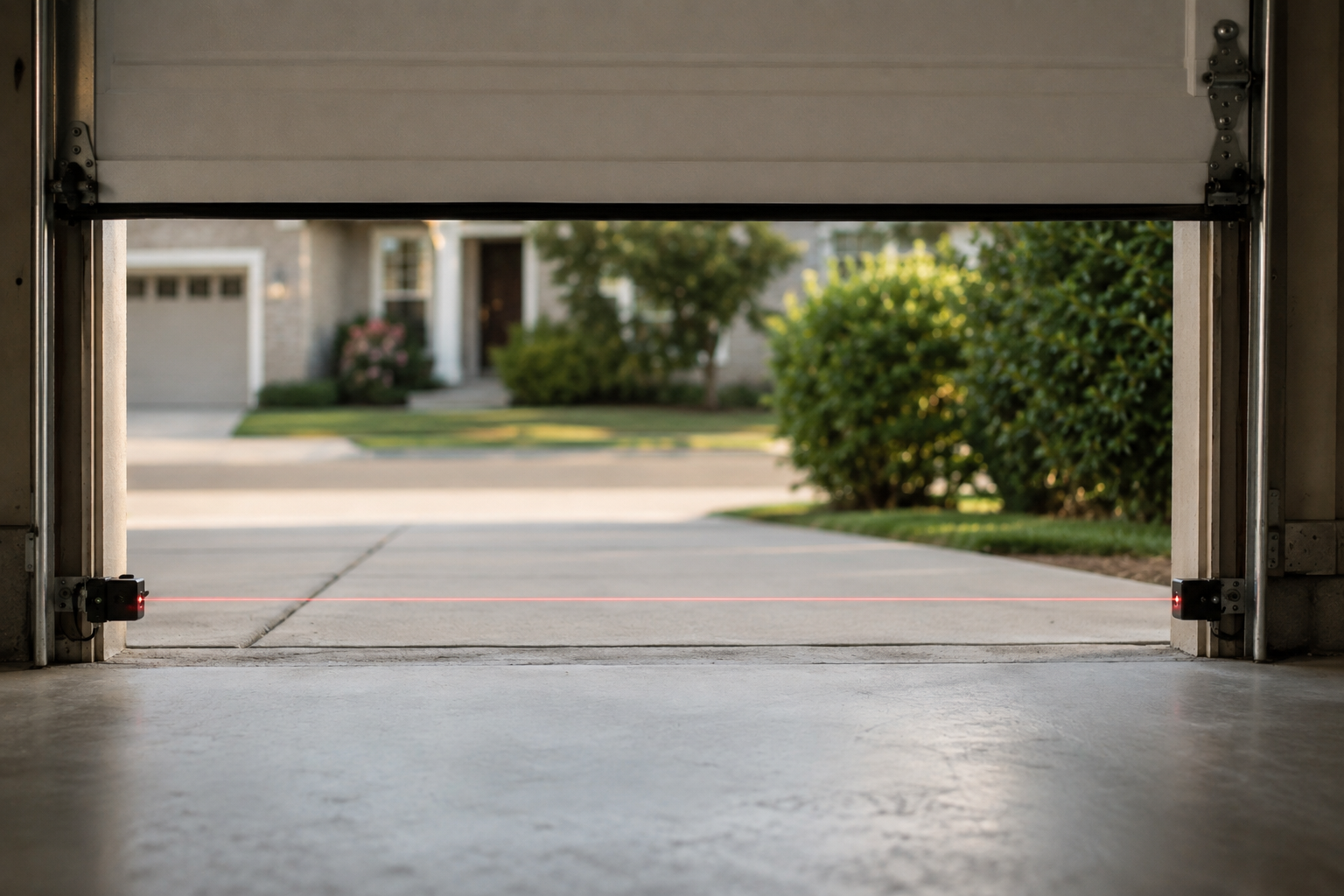
A garage door that rolls partway down and then goes straight back up is usually reporting a problem with its safety sensors, not announcing a failed opener. The two small photo eyes mounted near the floor on either side of the opening send an infrared beam across the doorway, and if that beam is broken, blocked, or simply not lining up, the opener refuses to complete the close. This is one of the most common calls our team takes, and in a large share of cases the cause is a sensor that has drifted out of alignment or a lens with a film of dust on it.
Why Does My Garage Door Reverse Before It Closes?
Because it is designed to. Since January 1, 1993, federal law has required every residential garage door opener sold in the United States to include entrapment protection, and photoelectric sensors are the most common way manufacturers meet that requirement. When the beam between the two sensors is interrupted at any point during the close, the opener stops and reverses the door to fully open. That behavior is the safety system working correctly, and a door that reverses is not a door that has broken.
What varies is why the beam is being interrupted. A cardboard box, a bicycle wheel, a bag of mulch, or a coiled hose sitting just inside the door line will do it. So will a sensor bumped out of position by a car door or a snow shovel. So will a spider web across the lens, which is common enough in Southeastern Pennsylvania garages that our technicians check for it as a matter of routine. You can read more about how these systems are meant to behave on our garage door safety page.
One thing to be clear about: never tape the sensors together, aim them at each other off the brackets, or hold the wall button down to force the door closed past a fault. Those workarounds disable the exact protection that keeps a closing door from coming down on a child or a pet.
How Do You Check If Garage Door Sensors Are Aligned?
Start by looking rather than touching. Stand inside the garage and check both sensor housings. According to DASMA Technical Data Sheet 364, the photoelectric beam must sit no higher than six inches above the garage floor, the sensors must be within six inches of the door's path measured perpendicular to the door, and they are typically installed up to twenty feet apart. If one unit is visibly higher, lower, or twisted compared to the other, that mismatch alone can break the beam.
Next, clear the path. Move anything within a foot or so of the door line on both sides, including items that are not directly in the opening but close enough to clip the beam at an angle.
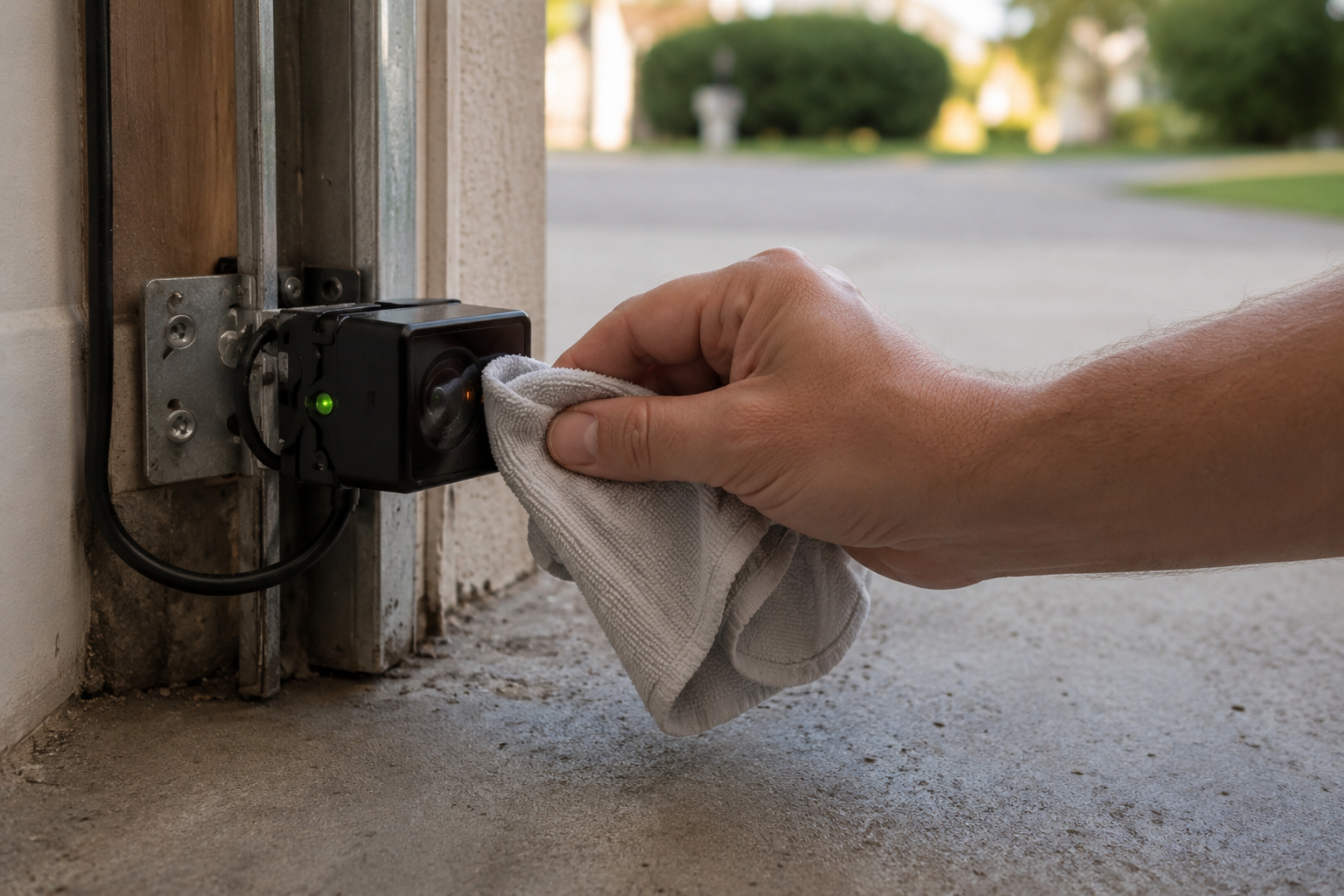
Then clean the lenses. A soft dry cloth is all that is called for. Wipe each lens gently, and check for cobwebs, road salt residue, and the grey dust that settles on everything in a garage over a winter. Do not use glass cleaner, solvents, or a wet cloth on the housings.
Sensors that look aligned are not necessarily aligned. The beam is invisible and the tolerance is tight, so a housing that appears straight to the eye can still be off by enough to fault. That is what the indicator lights are for. DASMA recommends testing the photoelectric sensors monthly, which takes about a minute once you know what you are looking at.
What Do the Indicator Lights on Garage Door Sensors Mean?
Each sensor carries a small LED, and between them they tell you almost everything. Our technicians read those two lights before anything else on a no-close call.
The sending unit's light is typically amber or yellow and should be steady whenever the unit has power. The receiving unit's light is typically green and should also be steady, which indicates it is receiving a clean beam. Manufacturers vary in colour and placement, so check the label on the housing if yours differ.
A receiving light that is blinking, flickering, or off means the beam is not landing. That points to misalignment, an obstruction, direct sunlight washing out the receiver at certain times of day, or a wiring fault at the terminal. A sending light that is off entirely usually means the unit is not getting power at all, which is not an alignment problem and is not something to chase at the terminal block yourself. That is a job for garage door opener repair.
Is a Reversing Door Always a Sensor Problem?
No, and this is where a lot of homeowners spend money on the wrong thing. If the sensor lights are both solid, the lenses are clean, the path is clear, and the door still reverses, the sensors are almost certainly reporting correctly and something else is stopping the door.
The two usual culprits are travel limits and force settings. The travel limit tells the opener where the floor is. If it is set too low, the opener drives the door into the concrete, reads the resistance as an obstruction, and reverses under the UL 325 rule that requires the opener to reverse within two seconds of contacting something. Force settings work the same way at lower thresholds. A door reversing at the same point every single time often points here rather than at the photo eyes.
Mechanical drag produces the identical symptom. A bent track section, a seized roller, a frayed cable, or a door out of balance all add resistance the opener interprets as an obstruction. Travel limits and force settings are opener adjustments, and our technicians set them with the door on a manual release first, because adjusting force on a door that is binding mechanically hides a real problem behind a software setting. If your checks came up clean, that is the point to book garage door repairs rather than keep adjusting.
How Fast Can a Technician Reach My Home in Chester County?
Early Birds Garage Doors offers same-day service across the Main Line and greater Philadelphia area, operating out of Devon and serving homeowners throughout Southeastern Pennsylvania and South Jersey. A door stuck open is a security problem as much as a convenience one, so sensor and no-close calls are treated as priority work rather than scheduled out. Coverage across Wayne, Berwyn, Malvern, Paoli, Bryn Mawr, and King of Prussia is listed on our service areas page.
A door that reverses is telling you something specific. Clear the path, clean the lenses, and read the lights, and you will resolve a good share of these in a few minutes. When the lights are solid and the door still will not close, the answer is in the opener's limits or in the door's mechanics, and both are worth handing to experienced garage door contractors rather than working through by trial and error. Early Birds Garage Doors services residential systems from every major manufacturer, including LiftMaster, Chamberlain, Clopay, Amarr, and Wayne Dalton. Call our garage door contractors at (610) 616-5255 for a same-day diagnosis.